


The Data-Driven Path to Green Operating Theatres
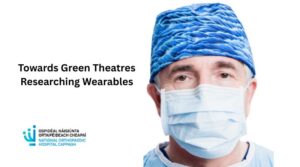
At the National Orthopaedic Hospital Cappagh (NOHC), achieving medical excellence means caring for both our patients and our environment. Operating theatres are uniquely resource-intensive hotspots, occupying only a small fraction of a Hospital’s physical footprint yet generating up to 70% of its total waste volume. Driven by single-use disposable devices, heavy plastic packaging, and sterile blue wrapping, the environmental footprint of surgery is significant. However, transitioning to green healthcare cannot rely on guesswork; it requires a measured, research-backed approach to ensure that patient safety and clinical efficacy are never compromised.
Diagnosing the Problem Through Clinical Research
We cannot reduce what we do not measure. To effectively transform our surgical environments, we must first diagnose the exact source of our emissions.
Understanding Waste Generated during Primary Hip and Knee Replacement Surgery
In 2023, a landmark research project initiated by NOHC evaluated the waste footprint of joint replacement surgeries, procedures that are rapidly rising globally due to the increasing prevalence of osteoarthritis.
Led by exchange medical student Mr Arthur Drouaud under the supervision of Prof. John O’Byrne, and with key contributions from trainee Dr Peggy Miller, the study quantified the carbon emissions of our most common procedures:
- Primary Knee & Hip Replacements: Generate 15.82 kg and 14.64 kg of CO2, respectively.
- Revision Knee & Hip Replacements: Generate up to 23.58 kg and 23.50 kg of CO2 due to extended surgery times, specialised instrumentation, and additional implant packaging.
- CSSD Blue Wrap: Identified as a major operational culprit, contributing an average of 13.5% of total operating room waste.
This precise data strips away assumptions, allowing us to implement highly targeted solutions without disrupting the seamless delivery of surgical care.
Exploring the Sustainability and Feasibility of Reusable Surgical Headgear
In 2025, this measured, evidence-based approach was applied to another research programme: “A Sustainability and Feasibility Assessment of Reusable Surgical Headgear in an Orthopaedic Hospital.”
The comprehensive cradle-to-grave Life Cycle Assessment (LCA) conducted in this study provides the exact scientific framework needed to balance carbon reductions with sterile safety standards. Led by Dr Raphael Alsama, Dr Paul McCarroll, Ciara Doran, Mr. James Cashman, and Prof. John O’Byrne, this study utilised a comprehensive life cycle assessment to prove that shifting from disposable caps to reusable headgear yields an estimated annual reduction of 91 kg of CO2. Crucially, the study also mapped out trade-offs, such as increased water consumption from industrial laundering, highlighting why rigorous data is vital before instituting Hospital-wide policy changes.
Collaborative Progress
Healing our environment requires the same clinical rigour as healing a patient: a thorough, research-backed diagnosis must always precede an effective intervention.
By scrutinising pre-packaged surgical sets, reassessing the necessity of single-use instruments, and optimising recycling pathways without compromising sterility, NOHC is building a blueprint for sustainable surgery. This ongoing research has successfully united our operating theatre personnel. Together, we remain fully committed to advancing green healthcare, ensuring that our stride toward environmental sustainability goes hand-in-hand with clinical safety and medical excellence.